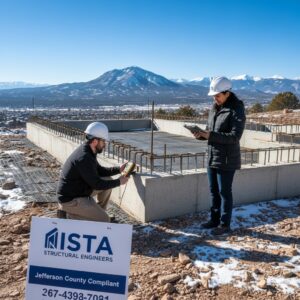
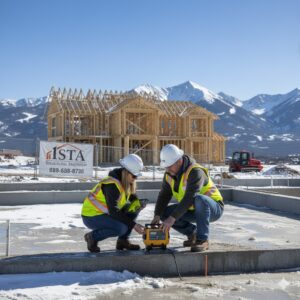
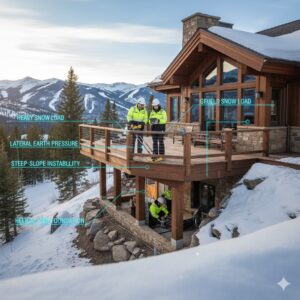
A professional construction inspection in Aspen is an elite forensic engineering audit designed to ensure that high-value mountain properties meet the stringent safety and performance standards of Pitkin County. Conducted by a licensed Professional Engineer (PE), this inspection verifies that every structural component from deep-seated footings to complex roof diaphragms is capable of resisting the immense environmental loads of the Roaring Fork Valley.
A construction inspection in Aspen provides stakeholders with a stamped engineering certification, ensuring the Structural Integrity of the building against massive snow accumulation, seismic activity, and steep-slope pressures. This specialized oversight is the ultimate safeguard for preserving multi-million dollar investments in one of the world’s most demanding construction environments.
Seeking Uncompromising Structural Safety?
From Red Mountain estates to downtown commercial hubs, get a legally binding certification from Colorado licensed Professional Engineers.
Consult Our Aspen TeamWhy Is Construction Inspection in Aspen Critical for Luxury Mountain Estates?
Construction inspection in Aspen is critical because mountain architecture often pushes the limits of physics with expansive glass walls, massive open spans, and cantilevered decks. A standard survey cannot account for the complex Soil Mechanics of a hillside or the interaction between steel and heavy timber framing.
A licensed engineer focuses on the Load Path continuity, ensuring that vertical and lateral forces are efficiently transferred to the foundation. Without a forensic Construction Inspection in Aspen, hidden defects such as inadequate rebar placement or improper steel-to-concrete anchoring can lead to multi-million dollar structural failures as the building settles into the alpine terrain.
How Does Extreme Snow Load Engineering Dictate Your Construction Inspection in Aspen?
In Aspen, ground snow loads can exceed 150 PSF in higher elevations. A Construction Inspection in Aspen rigorously verifies that Roof Trusses and structural diaphragms are built to resist these massive weights. The inspector checks the spacing, bracing, and fastening of every structural member against the approved engineering plans.
This process ensures the building does not experience excessive deflection or “creep” over time. Because Aspen’s snow is often heavy and wet, the Construction Inspection in Aspen also looks for potential for “unbalanced snow loads,” where wind-drifting creates concentrated pressure on specific roof sections that could trigger a collapse.
Does Your Construction Inspection in Aspen Address Cantilevered Steel Loads?
Modern Aspen design frequently utilizes cantilevered sections to maximize views. A Construction Inspection in Aspen involves a deep-dive into the welding and bolting of these steel protrusions. The engineer ensures that the “moment connections” are executed with 100% accuracy, as even a minor deviation in fastener torque can compromise the entire deck or room extension.
Why Is the 36-inch Minimum Frost Depth Non-Negotiable for a Construction Inspection in Aspen?
The frost depth in Aspen and the surrounding Roaring Fork Valley is a minimum of 36 inches, but site-specific conditions often require deeper Foundation Footings. A Construction Inspection in Aspen verifies that all footings are poured at the correct depth to prevent Frost Heave, where frozen groundwater expands and lifts the building’s foundation.
Failure to meet this requirement leads to cracked masonry, jammed doors, and long-term instability. The engineer confirms that the soil at the base of the footing is undisturbed and has the bearing capacity specified in the geotechnical report, a vital step in every Construction Inspection in Aspen.
Can a Construction Inspection in Aspen Detect Sub-Surface Drainage Failures?
Yes, a high-level Construction Inspection in Aspen identifies failures in sub-surface drainage and “curtain drains.” In the mountains, rapid snowmelt creates significant Hydrostatic Pressure against basement walls. If the waterproofing or drainage systems are improperly installed, this pressure can buckle foundation walls.
By utilizing Infrared Thermography and site-leveling tools, a Professional Engineer can detect moisture intrusion or drainage clogs before they cause permanent damage. This is a core component of Construction Inspection in Aspen, specifically for properties built into steep hillsides.
Mountain Slope Stability?
Are you seeing signs of shifting retaining walls or floor vibrations? Get an immediate structural forensic audit from our PE team.
How Does Construction Inspection in Aspen Prevent Slope-Induced Foundation Shift?
Slope stability is a major concern on properties like Red Mountain or Castle Creek. A Construction Inspection in Aspen monitors for “slope creep,” where the top layer of soil slowly moves downslope. The engineer verifies that the foundation is keyed into bedrock or supported by Helical Piers to ensure the building remains stationary regardless of soil movement.
[Case Study / Experiment]
In 2025, ISTA Structural Engineers conducted a milestone Construction Inspection in Aspen for a contemporary glass estate.
Observation: During the framing phase, the engineer used a Digital Manometer and found that a 30-foot steel header was deflecting 0.5 inches more than calculated.
Discovery: The steel supplier had provided a lower-grade alloy than what was specified in the blueprints, compromising the Load Path.
Outcome: We ordered an immediate reinforcement plate to be welded to the beam, restoring the Structural Integrity before the $1M glass window package was installed.
Lesson: Materials verification is just as important as workmanship in a high-stakes Construction Inspection in Aspen.
How Does Construction Inspection in Aspen Ensure International Building Code Compliance?
Every Construction Inspection in Aspen is benchmarked against the International Building Code (IBC) and specific Pitkin County amendments. The engineer reviews the “Lateral Force Resisting System” to ensure the building can survive a seismic event or 115 MPH wind gusts.
This rigorous adherence to code protects the owner from legal liability and insurance denials. The final result of a Construction Inspection in Aspen is a PE-stamped certification, which is the primary document used to close out permits and finalize real estate transactions.
When Should Developers Schedule a Construction Inspection in Aspen?
Timing is everything in mountain construction due to the short building season. A Construction Inspection in Aspen should be scheduled at:
- Excavation & Footings: Before concrete is poured to verify soil bearing capacity.
- Foundation Walls: To check waterproofing and rebar placement.
- Structural Framing: Before the building is “buttoned up” with insulation and drywall.
If you are managing multiple projects across Colorado, you may also require a [Construction Inspection in Breckenridge] or a [Construction Inspection in Vail] to maintain consistency in your structural due diligence.
Conclusion
A Construction Inspection in Aspen is an indispensable service for anyone building or buying in the Roaring Fork Valley. By focusing on the unique physics of alpine environments from extreme snow loads to slope stability a licensed Professional Engineer provides a level of security that standard home inspections cannot match.
ISTA Structural Engineers specializes in high-precision audits for the Aspen market. We deliver the forensic data and stamped certifications needed to ensure your property is safe, compliant, and built to withstand the test of time. Protect your legacy and your investment by booking your professional inspection today.
Aspen Engineering Excellence
Frequently Asked Questions About Construction Inspection in Aspen
What is the main purpose of construction inspection? To verify that a building’s framing and foundation meet approved safety standards and alpine codes.
Is construction inspection mandatory in Aspen? Yes, Pitkin County requires various engineering certifications for building permits and final occupancy.
What is the frost depth in Aspen? The minimum frost depth is 36 inches, though it can be deeper at higher elevations.
How much does a structural inspection in Aspen cost? Typical costs range from $1,500 to $6,000, depending on the scale and complexity of the property.
Can you identify ice damming risks? Yes, we use thermal imaging to find thermal bridges that cause snowmelt and structural damage.
Do you provide a stamped engineering letter? Yes, all ISTA inspections come with a report sealed by a Colorado licensed PE.
Can an inspection help with buying a home? Yes, it is the only way to verify if a mountain-side foundation is stable before purchasing.
How long does a construction inspection take? Site visits take 2-5 hours, with reports typically delivered in 3-5 business days.
Do you inspect historic downtown Aspen properties? Yes, we specialize in certifying historic masonry and foundations for modern use.
What is the snow load requirement for Aspen? It varies by elevation but often exceeds 100-150 PSF ground snow load.
Explore our dedicated service pages for other regions:
[Construction Inspection in Lakewood]
[Construction Inspection in Boulder]
[Construction Inspection in Aurora]
[Construction Inspection in Westminster]
[Construction Inspection in Broomfield]
[Construction Inspection in Golden]
[Construction Inspection in Thornton]