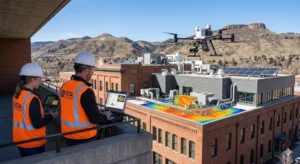
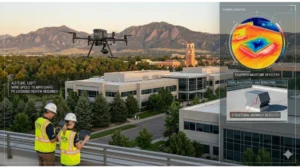
Foundation inspection in Broomfield is a high-precision structural evaluation performed by a licensed Professional Engineer to assess the stability of a building against the region’s diverse geological hazards, including expansive claystone and soft alluvial clays.
In Broomfield, Colorado, this process is critical due to the presence of the Laramie Formation and Pierre Shale, which can exert significant swelling pressure on footings, necessitating a formal engineering certification for both safety and municipal code compliance.
For property owners in zip codes such as 80023 or 80020, a professional foundation inspection provides the technical evidence required for real estate transactions, 2024 building code permits, and structural warranty claims. The process utilizes Digital Manometer surveys to detect elevation variances as small as 1/10th of an inch. Unlike a general inspection, an assessment in Broomfield specifically analyzes the risk of “consolidation” in the Piney Creek Alluvium strata common near local creek beds.
Why is a foundation inspection in Broomfield, CO (80020, 80023) essential for modern homeowners?
The geology of Broomfield, particularly in high-growth areas like Anthem and McKay Landing, sits atop a complex transition of sedimentary rock. A foundation inspection is essential here because these soils can act as a “liquid” under heavy load or expand like a sponge when moisture levels shift.
In the 80023 and 80020 areas, residential properties often face “differential movement,” where one corner of the home sinks while another rises. A professional engineering inspection identifies these patterns early, preventing the “unzipping” of drywall and structural framing.
Given Broomfield’s status as a consolidated city and county, the legal requirements for structural integrity are rigorous, making an engineer-led inspection the only way to truly verify a home’s long-term value.
How do the Laramie Formation and Pierre Shale impact structural stability in Broomfield?
The Laramie Formation and Pierre Shale are the primary geological “bad actors” in Broomfield. During a foundation inspection, we look for signs that the claystone within these formations is reacting to groundwater. While the Laramie Formation often has a “low” swell potential (0-2%), the swelling pressure can still reach nearly 2,000 psf, which is enough to crack standard basement slabs.
In southern Broomfield, the Pierre Shale is more aggressive, with smectite clay content that can cause severe heave features.
An inspection determines if the home’s foundation was properly designed with Void Forms or if it is resting directly on these expansive layers. Identifying the specific bedrock depth is vital, as it dictates whether the home needs Helical Piers to reach stable strata.
What specific 2024 Broomfield building codes must a foundation inspection satisfy?
As of April 15, 2026, all structural work in Broomfield must comply with the newly adopted 2024 Building Code Package, which includes updated International Residential Code (IRC) standards. A foundation inspection must verify that the structure meets the required Frost Depth of 36 inches and the new Colorado Low Energy and Carbon Code (LECC) requirements for foundation insulation and sealing.
Furthermore, Broomfield requires that any engineering inspection results be submitted as a Signed and Sealed report to the Building Division before rough or final inspections can be approved. This ensures that the foundation meets local “Design Criteria,” including a 30.0 psf snow load and site-specific wind exposure classifications, which are critical for the structural integrity of larger homes in Legacy Ridge or Broadlands.
How does a professional foundation inspection in Broomfield address high-moisture alluvial clays?
Broomfield’s landscape is dotted with ancestral creek beds containing Piney Creek Alluvium. A professional foundation inspection in these zones often found near Walnut Creek or Big Dry Creek addresses the risk of “settlement” in saturated organic clays. Geotechnical data for Broomfield has shown moisture levels as high as 66% in these areas.
If an inspection reveals that the foundation is resting on soft alluvial clay, the engineer may recommend Pressure Grouting or moisture-treatment protocols. The goal is to ensure the Alluvium (which can vary from 3 to 11 feet deep in Broomfield) has been properly consolidated or bypassed by the foundation’s load-bearing elements to prevent the house from “sinking” into the soft earth.
What are the primary indicators of “settlement” vs. “heave” in Broomfield residential properties?
Distinguishing between settlement and heave is a core task during a foundation inspection. In neighborhoods like Redleaf, settlement is often indicated by “stair-step” cracks that pull away from the home, suggesting the soil is collapsing. Conversely, heave—common in the 80021 area—causes the center of the basement floor to “tent” or push upward.
In Broomfield residential properties, we also look for “nail pops” in the ceiling and gaps between the garage floor and the side walls. If the Foundation Heave is active, it will often pinch doors shut during the wet spring months and allow them to open again during the dry Colorado winters. An engineer uses these clues, along with an altimeter survey, to determine which direction the foundation is moving and why.
[Case Study / Experiment]
Location: Broomfield, CO (80023, McKay Landing area) Observation: A 12-year-old home exhibited significant 2.5-inch elevation variances and “crushing” of the basement door frames. Methodology: Our engineering team performed a Forensic Elevation Map and cross-referenced it with the Laramie Formation bedrock depths for the specific lot. Discovery: The foundation inspection revealed that while the home had caissons, they were “friction-based” rather than “end-bearing,” and a shallow water table (measured at 4 feet) was causing the friction to fail. Outcome: We designed a remediation plan to stabilize the moisture around the foundation and installed Crack Monitors to track the success of the new drainage swales. Lesson Learned: In Broomfield’s alluvial zones, caisson depth and groundwater management are equally important; without a P.E. inspection, the root cause (water table interference) would have been missed.
How do Broomfield’s shallow water tables (1.7 to 7 feet) impact foundation inspection results?
Broomfield has surprisingly shallow groundwater, with water tables often measured between 1.7 and 7 feet deep. During a foundation inspection, this “Shallow Water Table” is a major red flag for building humidity and structural degradation.
High groundwater can lead to Hydrostatic Pressure, which pushes water through the concrete pores of the foundation walls. If the inspection finds evidence of Efflorescence (white salty powder) or mold at the base of the walls, it indicates that the Perimeter Drain or Sump Pump is failing to keep the water table at bay. In the 80516 area, this moisture can also “soften” the claystone bedrock, reducing its bearing capacity and leading to unexpected settlement.
Why is a Professional Engineer’s seal mandatory for all Broomfield structural certifications?
In Broomfield, a Professional Engineer (P.E.) seal is mandatory for foundation certifications because it provides a legal guarantee of technical accuracy. The City and County of Broomfield Building Division will not accept “structural letters” from unlicensed contractors or home inspectors for permit closeouts.
The P.E. seal signifies that the foundation inspection was performed by an expert who understands the complex “settlement/consolidation” risks of local soils. This seal is your protection during a home sale in Interlocken or Miramonte, as it provides the “Authority” and “Trustworthiness” required by title companies and mortgage lenders. It ensures that the structural assessment is based on repeatable science rather than subjective observation.
Conclusion
Navigating the geological “settlement” and “heave” risks of Broomfield requires a forensic engineering approach. Whether you are dealing with the expansive shales of 80023 or the shallow water tables of 80020, a foundation inspection in Broomfield is the most effective way to secure your property’s future. ISTA Engineers provides the local geotechnical knowledge and 2024 code expertise to ensure your foundation remains stable for decades to face Colorado’s environmental challenges.
Suspect Foundation Movement in Broomfield? Ensure your home is compliant with the 2024 codes. Contact a licensed Professional Engineer today.
Call Now: (720) 740-4060 Request a Consultation: istaengineers.com/contact-us/
FAQ – Foundation Inspection in Broomfield
- How much does a foundation inspection cost in Broomfield (80023)? A standard engineering foundation inspection in Broomfield typically ranges from $575 to $875, depending on the complexity of the alluvial soil conditions.
- Does Broomfield’s 2024 building code update affect existing homes? The 2024 code applies to all new permits, including basement finishes and additions, which now require updated structural certifications.
- What is the frost depth for foundations in Broomfield? The City and County of Broomfield officially requires foundations to be at least 36 inches below finished grade to prevent frost heave.
- Why is the water table so high in some Broomfield neighborhoods? Neighborhoods near creek beds or the Great Western Reservoir often sit on the Piney Creek Alluvium, where groundwater can be as shallow as 1.7 feet.
- Can a foundation inspection detect coal mine subsidence in Broomfield? While the USGS map shows no major past coal mining sitewide, a P.E. inspection will check for the specific “ground sinking” patterns associated with subsidence just in case.
- What is “moisture-treated fill” in Broomfield construction? It is soil that has been chemically or physically altered to have a specific moisture content (Liquid Limit < 40) to prevent expansion after the house is built.
- Will a foundation inspection help with my “McKay Landing” warranty? Yes, an independent P.E. report is the gold standard for proving structural defects to builders during a warranty claim.
- How long is a Broomfield engineering report valid? Most real estate and municipal entities accept a structural report for 6 to 12 months, provided no major weather events have occurred.
- Do I need an inspection if my basement is finished? Yes, an engineer can use an altimeter to “see” through the floor finishes and determine if the underlying slab is heaving.
- What is the “Denver Formation” and is it in Broomfield? The Denver Formation sits below much of the Metro area; in Broomfield, it often interacts with the Laramie Formation, creating pockets of expansive claystone.