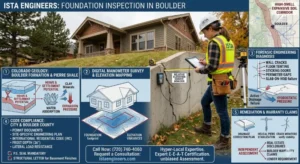
Foundation inspection in Westminster is a technical structural evaluation performed by a licensed Professional Engineer to determine the integrity of a building’s support system against the region’s aggressive expansive soils. In Westminster, Colorado, this process is essential for identifying “heave” and “settlement” caused by the Denver Formation claystone, ensuring that properties remain safe and compliant with both Adams County and Jefferson County building codes.
For residents in zip codes such as 80031 or 80021, a professional evaluation provides a certified foundation inspection report necessary for real estate disclosures, structural permits, and warranty claims. The process utilizes Digital Manometer surveys and Forensic Engineering to map elevation variances. Unlike a general inspection, an assessment in Westminster focuses on the specific interaction between the Rocky Flats Alluvium and the home’s foundation footprint.
Why is a foundation inspection in Westminster, CO (80031, 80021) critical for long-term structural health?
The geography of Westminster, particularly in the 80031 and 80021 areas, is situated on a “high-swell” corridor. A specialized foundation inspection is critical here because the soil contains minerals that expand significantly when hydrated, putting thousands of pounds of pressure on your home’s concrete.
In neighborhoods like Orchard Pointe and Legacy Ridge, houses are often built on complex soil strata that require specific engineering designs. An inspection identifies if the original Drilled Piers or Caissons are performing as intended. Without this professional oversight, minor drywall cracks can quickly evolve into major structural shifts that compromise the building’s “load path” and significantly decrease property value.
How does the “Denver Formation” claystone impact foundations in Walnut Creek and West Ranch?
The Denver Formation is a geological layer prevalent in Walnut Creek and West Ranch that consists of interbedded sandstone and claystone. During a foundation inspection, we often find that this claystone is the primary culprit for “basement floor heave.”
When moisture from lawn irrigation or heavy rain reaches this claystone, it expands upward, causing the basement slab to crack and “tent.” In Westminster, this pressure can be so intense that it lifts internal partition walls, causing doors on the upper floors to stick. An engineering evaluation maps these pressure points to determine if the Slab-on-Grade is failing and if a Structural Floor system is required for remediation.
What specific Westminster building codes (Adams vs. Jefferson County) must an inspection satisfy?
Westminster is unique because it spans two counties. A foundation inspection must satisfy the Adams County Building Department for homes east of Sheridan Blvd and the Jefferson County Building Division for those to the west. Both require a Professional Engineer (P.E.) seal on all structural certifications.
The City of Westminster Building Division requires that any foundation stabilization, such as Helical Piers, be backed by a site-specific engineering plan. This plan must verify that the repair meets the International Residential Code (IRC) for frost depth and lateral load resistance. Failure to provide a sealed report from a licensed engineer can result in the denial of permits for basement finishing or structural additions.
How does a professional foundation inspection in Westminster address perched water tables near Standley Lake?
Properties located near Standley Lake often encounter “perched” water tables pockets of groundwater trapped above impermeable clay layers. A professional foundation inspection in these areas specifically checks for “hydrostatic pressure” buildup against basement walls.
This trapped water can lead to “weeping” through concrete pores and failure of the Perimeter Drain system. The inspection involves testing the Sump Pump capacity and evaluating the Window Well drainage. In Westminster, managing this perched water is vital to preventing “softening” of the soil beneath the footings, which can lead to rapid settlement in the 80021 area.
What are the primary indicators of “slab-on-void” failure in Westminster residential properties?
Many modern Westminster homes utilize a “slab-on-void” design, where the concrete floor is poured over cardboard forms to allow the soil to expand without touching the floor. A primary indicator of failure is when the soil expands so much that it crushes the Void Forms, causing the floor to heave.
During a foundation inspection, we look for “perimeter gaps” that have disappeared or floor tiles that are tenting in the center of the basement. In Hyland Hills, another common indicator is the separation of the staircase from the wall. These signs suggest that the foundation is no longer “floating” correctly and is being directly impacted by the swelling Denver Formation soils below.
[Case Study / Experiment]
Location: Westminster, CO (80031, Walnut Creek subdivision) Observation: A 5-year-old home exhibited 2-inch floor variances and cracks in the granite countertops. Methodology: Our team performed a Relative Elevation Survey and used a Moisture Meter to scan the basement perimeter. Discovery: The foundation inspection revealed that the homeowner’s downspouts were discharging directly into the foundation’s “backfill zone,” saturating the expansive claystone. Outcome: We designed a Drainage Correction plan that diverted water 10 feet away from the foundation and installed Crack Monitors to verify the foundation stabilized. Lesson Learned: In Westminster, many “foundation failures” are actually drainage failures that can be solved without expensive piering if diagnosed early by a Professional Engineer.
How do fluctuating moisture levels in North-Central Colorado impact foundation inspection results?
Westminster’s climate characterized by sudden spring snowmelts and hot, dry summers causes the soil to go through intense “shrink-swell” cycles. A foundation inspection conducted in the dry month of August might show different results than one conducted in a wet April.
Engineers in Westminster account for this by looking for “active” versus “dormant” cracks. An active crack often has clean, sharp edges and shows signs of recent movement. By understanding the Hydrology of the 80031 zip code, the engineer can predict how the foundation will behave when the next weather cycle hits, providing a more accurate long-term stability forecast.
Why is a Professional Engineer’s seal mandatory for all Westminster foundation inspections?
The Professional Engineer (P.E.) seal is mandatory because it ensures the inspection was conducted by an expert who is legally and ethically bound to provide an unbiased, technically sound assessment. In Westminster, the complex dual-county regulations and aggressive soil chemistry require a high level of specialized training.
The seal provides “Expertise” and “Trustworthiness” core components of E-E-A-T. Lenders, title companies, and the City of Westminster rely on the P.E. seal to guarantee that the foundation inspection report is an accurate reflection of the building’s safety. For a homeowner, this seal is the ultimate protection, ensuring that any recommended Foundation Repair is based on physics and soil science rather than sales quotas.
Conclusion
Navigating the expansive soils of Westminster requires a proactive and professional approach. Whether you are dealing with perched water near Standley Lake or heave in Legacy Ridge, a foundation inspection in Westminster is the most effective way to protect your home’s value and safety. ISTA Engineers provides the hyper-local expertise and forensic tools needed to diagnose and resolve your foundation concerns.
Worried About Your Westminster Foundation? Get a definitive answer from a licensed Professional Engineer.
Call Now: (720) 740-4060 Request a Consultation: istaengineers.com/contact-us/
FAQ – Foundation Inspection in Westminster
- How much does a foundation inspection cost in Westminster (80031)? A residential engineering inspection in Westminster typically ranges from $550 to $850, depending on the home’s size and the complexity of the soil issues.
- Does Westminster require a structural engineer’s letter for a basement finish? Yes, if you are adding walls or changing the layout, the Building Division often requires a structural letter to ensure the floor system can handle the new load.
- What is the difference between Adams and Jefferson County inspection rules in Westminster? While the technical standards are similar, the reporting formats and permit filing processes differ between the two county seats.
- Why are foundations in Legacy Ridge prone to movement? Many parts of Legacy Ridge are built on elevated areas where the Denver Formation claystone is closer to the surface, leading to higher swell potential.
- Can a foundation inspection help me with a structural warranty claim? Yes. An independent P.E. report is the strongest evidence you can provide to a builder or insurance company for a warranty claim.
- How long does an inspection take in Westminster? Expect our engineer to be on-site for 1.5 to 3 hours to perform a complete elevation survey and exterior assessment.
- Will the inspection identify why my sump pump runs constantly? Yes, we evaluate the groundwater levels and perimeter drainage to determine if the pump is managing a “perched” water table.
- Is it safe to buy a home with foundation cracks in Westminster? It can be, provided you have a foundation inspection by a P.E. to determine if the cracks are cosmetic or indicate a structural failure.
- What are “void forms” in Westminster foundations? These are degradable cardboard spacers used under concrete to create a “buffer zone” for expansive soil to grow into without lifting the house.
- Do I need an inspection if I don’t see any cracks? If your home is over 10 years old or located near Standley Lake, a “baseline” inspection is a good idea to catch drainage issues before they cause cracks.