An expansive soil foundation has to cope with clay that swells when it absorbs water and shrinks when it dries, and that movement can lift, crack, and twist a structure within a few seasons. Across Denver and the Front Range, this behavior shapes how engineers specify footings, slabs, piers, drainage, and site preparation. This guide explains what counts as expansive soil, how to identify it, which foundation systems suit which conditions, how treatment and repair work, what drives cost, and how to evaluate a lot before buying or building.
What Is Expansive Soil and What Is Considered Expansive Clay in Colorado?
Expansive soil is a fine-grained soil, usually clay, that changes volume significantly as its moisture content changes. Soil is considered expansive when laboratory testing shows high swell potential and a high plasticity index, meaning the clay absorbs water readily and holds it. Engineers call these soils expansive clay, and they are the main cause of soil heave under lightly loaded buildings.
Typical examples include bentonite-bearing clays, claystone weathered into clay, and some silty clays. Non-expansive soil, such as clean sand and gravel, drains freely and changes little in volume. Sites often contain both, which is why testing at the building location matters more than regional reputation.
How Does Shrink-Swell Behavior Work in Expansive Clay?
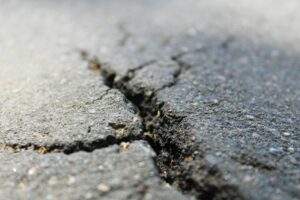
Shrink-swell behavior in expansive clay comes from water entering the spaces between flat clay mineral particles and pushing them apart. Montmorillonite, the main mineral in bentonite, swells far more than most other clay minerals. When the soil dries, the particles pull together and the ground shrinks, often leaving visible desiccation cracks.
Swelling soil can generate large pressures against anything that restrains it. Residential footings carry modest loads, so the heave pressure often exceeds the dead load and the soil lifts the structure. Heavier loads or deep, anchored foundations resist better, which is why foundation design for these soils concentrates on either isolating the structure from the soil or stiffening it.
Why Are Denver and Front Range Colorado Soils Prone to Heave?
Denver and the Front Range sit in a semi-arid climate with dry stretches punctuated by snowmelt and intense storms, so clay soils cycle between wet and dry. Claystone bedrock and clay-rich soils are common along the foothills corridor, and the Colorado Geological Survey documents swelling soils as a recognized regional hazard. Irrigation of lawns and landscaping adds water that the native ground never received.
Conditions vary block by block, so no map replaces a site-specific geotechnical investigation. Local building departments set the final foundation requirements, and many jurisdictions expect a soils report for new construction. A Colorado-licensed engineer should confirm local conditions before any design assumption is made.
What Problems Does Expansive Soil Cause for a Foundation?
Expansive soil causes uneven foundation movement that cracks concrete, distorts framing, and damages finishes. The movement is rarely uniform, so one part of a building rises or settles relative to another. Differential movement, not total movement, produces most structural damage.
Damage develops slowly and often seasonally, which leads owners to dismiss early signs. Cracks open in wet periods or dry periods, doors bind and release, and repairs fail to hold. Recognizing the pattern early keeps remedies smaller and cheaper.
How Does Edge-to-Center Moisture Differential Cause Soil Heave?
Edge-to-center moisture differential describes the difference in soil moisture between the perimeter of a slab and the soil beneath its middle. A slab shields the center from evaporation and rain, while the perimeter wets and dries with the weather. When the edge wets, the perimeter lifts and the slab dishes, and when the edge dries, the perimeter drops and the center domes.
Local leaks, poor grading, and downspouts discharging near the wall intensify the effect. A plumbing leak under a slab can swell a localized area of clay and create a pronounced hump. Trees that pull moisture from one side create the opposite problem, shrinking the soil beneath that side of the foundation.
What Foundation Damage Signs Point to Expansive Soil?
Foundation damage from expansive soil appears as a recognizable cluster of symptoms. A professional Foundation Inspection documents which of these are present and whether they are active. Common symptoms include:
- Stair-step cracks in brick or block walls, widening toward the top or corner
- Doors and windows sticking, or gaps opening above frames
- Uneven or sloping floors and cracks in tile or drywall at ceiling corners
- Slab cracks with one side higher than the other
- Gaps between the foundation and exterior soil, or between walls and trim
Not every crack signals expansive soil, since shrinkage and settlement cracks also occur in healthy concrete. The guide on foundation cracks when to worry explains how width, direction, and displacement separate cosmetic cracks from structural ones.
How Do You Tell If You Have Expansive Soil Before Design?
Expansive soil is confirmed through a geotechnical investigation, not by appearance. A geotechnical engineer drills borings, collects samples, and runs laboratory tests that measure swell and plasticity. Site observations can raise suspicion, but only testing quantifies the risk.
Visible clues include polygon-shaped shrinkage cracks across dry ground, sticky mud that clings to shoes after rain, and hard, blocky clay in excavations. Neighboring homes with patched cracks or tilted slabs offer further hints. These observations guide the scope of testing and do not replace it.
What Does a Geotechnical Report Show About Swell Potential and Plasticity Index?
A geotechnical report lists soil layers, groundwater observations, laboratory results, and foundation recommendations for the specific lot. Two results matter most for expansive soil. Swell potential, typically measured through swell-consolidation testing such as ASTM D4546, shows how much a sample expands under load when wetted. The plasticity index, derived from Atterberg limits testing under ASTM D4318, shows how much the soil’s behavior changes across its moisture range.
Reports also recommend a design approach, such as drilled piers, a stiffened slab, or removal and replacement of upper soils. The International Building Code, Chapter 18, requires soils investigation and foundation design that account for expansive soils when they are present. Engineers read the report alongside the structural plans to confirm that the foundation matches the stated conditions.
Are All Clays Expansive?
Not all clay soils are expansive, because swelling depends on mineral type, density, moisture, and confinement. Kaolinite-rich clays swell little, while montmorillonite-rich clays swell heavily. A clay that feels hard and dry may swell dramatically once it takes on water.
Soil type alone therefore does not decide the design. Dense, deeply confined clay beneath a heavy structure may behave very differently from the same clay near the surface under a patio. The report’s swell results at foundation depth carry the answer.
What Type of Foundation Is Best for an Expansive Soil Foundation Design?
The best expansive soil foundation depends on swell potential, soil depth, structure weight, and budget, so no single system wins everywhere. Drilled piers with grade beams isolate the structure from near-surface movement, while stiffened slabs tolerate movement without breaking. A geotechnical engineer and a structural engineer select the system together.
For ground-up projects, New Construction Design works best when soil testing precedes foundation layout. Choosing a foundation first and testing later risks costly redesign. Specifying the system against measured swell values avoids both under-design and unnecessary expense.
How Do Drilled Piers and Grade Beams Perform in Expansive Clay?
Drilled piers and grade beams transfer building loads to stable soil or bedrock below the zone of seasonal moisture change. Reinforced concrete piers extend deep, and the grade beams span between them. Void forms beneath the beams leave a gap that lets the clay swell without pressing upward on the concrete.
Piers must be designed for uplift as well as bearing, because swelling clay grips the shaft and tries to pull it upward. Engineers provide enough reinforcement and anchorage length in stable strata to resist that force. The system suits strongly expansive sites and heavier structures.
Which Foundation Design Fits Which Site?
Foundation selection follows the severity of expansion and the structure type, as the comparison below shows. Final choices rest on the geotechnical report and local code.
| Foundation system | How it works | Best for | Trade-offs |
|---|---|---|---|
| Drilled piers and grade beams with void forms | Loads bypass active clay; voids absorb swelling | High swell potential, heavier buildings | Higher cost, specialized drilling, voids must stay clear of backfill |
| Post-tensioned slab | Tensioned steel stiffens the slab against bending | Moderate swell, uniform plans | Cable damage risk from later cutting; relies on stable soil moisture |
| Reinforced waffle or ribbed slab | Deep ribs stiffen the slab against dishing and doming | Low to moderate swell | More excavation and formwork; less tolerance of severe heave |
| Over-excavation with non-expansive fill and conventional footings | Active clay is replaced with controlled fill | Shallow expansive layers | Depends on fill quality and drainage control |
A decision rule helps: deep or severe expansive layers favor piers, shallow or moderate layers favor stiffened slabs or soil replacement, and the structure’s weight and use refine the choice.
How Is Expansive Soil Treated and How Do You Fix Foundation Problems?
Expansive soil is treated by replacing it, chemically modifying it, or controlling its moisture. Foundation problems caused by that soil are fixed by stabilizing moisture conditions first and then repairing or supporting the structure. Treating the cause before repairing the damage prevents the same cracks from returning.
Soil treatment and structural foundation choice are separate decisions. A site can use treated soil under a stiffened slab, or untreated soil under piers. Engineers combine them when the risk justifies it.
Does Over-Excavation or Chemical Stabilization Work?
Over-excavation and replacement removes expansive clay below the building and substitutes compacted non-expansive fill. The method works best when the active layer is shallow and the fill is placed under engineered compaction control. The replacement zone must be graded and drained so water does not collect in it.
Chemical stabilization mixes lime, cement, or similar binders into the clay to reduce plasticity and swell. Lime treatment has long been used in road and pad construction, and results depend on soil chemistry and thorough mixing. Laboratory mix testing confirms the dosage before field use.
How Do Grading and Drainage Control Soil Moisture?
Site grading and drainage keep soil moisture steady around a foundation by moving water away from the structure. Positive slope away from the walls, gutters with extended downspouts, and sealed joints reduce wetting at the perimeter. Impermeable barriers or moisture breaks can limit lateral migration of water under slabs.
Below-grade utilities need protection because leaks saturate clay locally. Flexible connections and bedding in non-expansive material reduce the risk, and slab-penetrating lines need tolerance for movement. Retaining Wall Design on expansive sites also relies on free-draining backfill so swelling clay does not load the wall.
What Does an Expansive Soil Foundation Cost?
An expansive soil foundation costs more than a standard slab, and the exact figure depends on the system, soil depth, lot access, and local labor and material markets. Published per-square-foot numbers rarely apply because each site carries different swell conditions. Only local bids based on a site-specific geotechnical report give a usable price.
Owners who ask about a typical 2,000-square-foot foundation should treat any generic number cautiously. The same footprint can require shallow soil replacement on one lot and deep piers on the next. Repair work follows the same logic, as the guide on foundation repair cost explains for Colorado.
What Drives Cost Up or Down?
Foundation cost on expansive soil responds to a short list of engineering variables. Each one can be traced to the geotechnical report:
- Swell potential: higher swell requires deeper or stiffer systems
- Active zone depth: deeper active clay means longer piers or more excavation
- Structure weight and span: heavier loads change pier and beam sizing
- Site access and groundwater: drilling difficulty and dewatering add expense
- Drainage and grading scope: perimeter work reduces long-term risk
A standard slab price does not cover these items because it assumes stable, non-expansive ground. Treating that price as a baseline understates the project.
How Do You Get Comparable Bids?
Comparable bids start from one shared set of documents: the geotechnical report and the structural foundation plans. Contractors who price from different assumptions produce numbers that cannot be compared. Giving every bidder the same drawings and soils recommendations removes that gap.
Bid reviews should confirm that each quote lists pier depth, reinforcement, void form details, soil treatment, and drainage scope. Any bidder who proposes substituting a cheaper system should obtain written approval from the engineer of record. Local building departments also review such changes before permits are issued.
Should You Buy or Build on a Lot With Expansive Soil?
Expansive soil does not automatically disqualify a lot, because proper foundation design manages the risk. Buyers should avoid properties only when evidence shows active movement, unresolved drainage failures, or missing documentation. Most Front Range lots can be built on or maintained with the right engineering.
The decision rests on records and inspection rather than on the soil label alone. A home with a soils report, a matching foundation design, and well-managed drainage presents lower risk than an undocumented older home. Pre-purchase evaluation turns uncertainty into a price and a plan, as described in foundation inspection before buying a house.
Which Soils Report Questions Matter?
A buyer’s review of a soils report should answer a defined set of questions. Work through them in this order:
- What swell potential and plasticity index did the laboratory report?
- Which foundation system did the geotechnical engineer recommend?
- Does the built foundation match the recommended system?
- Did the builder follow the site drainage and grading recommendations?
- Do the report date and boring locations match this lot and house?
Red flags include a missing report, a slab on strongly expansive clay with no stiffening, active cracks with offset, and downspouts discharging at the wall. Several of these together justify negotiating or walking away.
Should You Hire a Geotechnical Engineer or a Structural Engineer?
A geotechnical engineer characterizes the soil, and a structural engineer designs the foundation that responds to it. Geotechnical work answers what the ground will do, and structural work answers how the building resists it. Projects on expansive clay normally need both.
Buyers evaluating an existing home usually start with a structural engineer who inspects the building, then add geotechnical testing if movement is active or records are missing. Builders order the geotechnical investigation first so the structural design starts from verified values.
What Do Engineers Commonly See With Expansive Clay Foundations Over Time?
Engineers commonly see expansive clay problems that trace back to moisture changes after construction rather than to the original design. Altered drainage, landscaping additions, and unrepaired leaks shift soil moisture and restart movement. A sound foundation can still suffer when the surrounding conditions change.
Typical mistakes include burying downspout outlets against the wall, planting trees close to the house, overwatering foundation beds, and cutting post-tension cables during later remodels. Another recurring pattern is patching cracks without identifying the moisture cause. Each of these mistakes is preventable with routine habits.
How Do Watering and Landscaping Habits Protect Foundations?
Consistent soil moisture around a foundation reduces seasonal swell and shrink cycles. During dry periods, slow, even watering near the perimeter prevents deep shrinkage cracks, while avoiding saturation prevents swelling. Drip irrigation placed away from the wall provides steadier moisture than frequent sprays.
Large trees draw moisture from clay and shrink the soil beneath nearby footings, so placement distance should scale with mature tree height. Shrubs and flower beds should sit with their irrigation off the wall line. Gutters, downspout extensions, and positive grade complete the system.
When Should You Call an Engineer?
Homeowners should call an engineer when cracks widen, floors slope noticeably, doors stop closing, or movement continues across seasons. Cracks with vertical offset, exterior gaps at the foundation, or sudden changes after a plumbing leak warrant prompt attention. Early evaluation limits the scope of repair.
A licensed engineer can document conditions, monitor movement, and recommend repairs or underpinning if needed. A Structural Inspection records the current condition so later changes can be measured against it. Local building departments require engineered plans for significant foundation repairs.
FAQ
What are the problems associated with expansive soil?
Expansive soil problems come from volume change as clay wets and dries. The movement cracks slabs and walls, tilts floors, and jams doors and windows. Differential heave across a foundation stresses framing and finishes, and repeated seasonal cycles can progressively enlarge damage if moisture is not controlled.
What type of foundation is best for unstable ground?
The best foundation for unstable ground depends on soil testing. Drilled piers with grade beams suit deep or severe expansive clay, while stiffened or post-tensioned slabs suit moderate conditions. A geotechnical report and structural design select the system, and local building codes confirm the final requirements.
How do you fix expansive soil problems around a foundation?
Fixing expansive soil problems starts with moisture control through grading, gutters, and leak repair. Soil replacement or chemical stabilization may follow, and structural repairs such as piering address existing damage. An engineer should evaluate the cause before any repair is selected, so the work addresses the source of movement.
Should I avoid a property with expansive soil?
A property with expansive soil is not automatically a bad purchase. Risk depends on the foundation type, drainage, and movement history. Buyers should request the soils report, compare it with the built foundation, and have an engineer inspect for active damage. Properties without documentation or with ongoing movement need caution.
Sources
- Expansive clay (Wikipedia)
- Atterberg limits (Wikipedia)
Explore Foundation Inspection by City
- Foundation Inspection
- Foundation Inspection in Denver
- Foundation Inspection in Wheat Ridge
- Foundation Inspection in Littleton
- Foundation Inspection in Highlands Ranch
- Foundation Inspection in Greeley
- Foundation Inspection in Fort Collins
- Foundation Inspection in Centennial
- Foundation Inspection in Castle Rock